

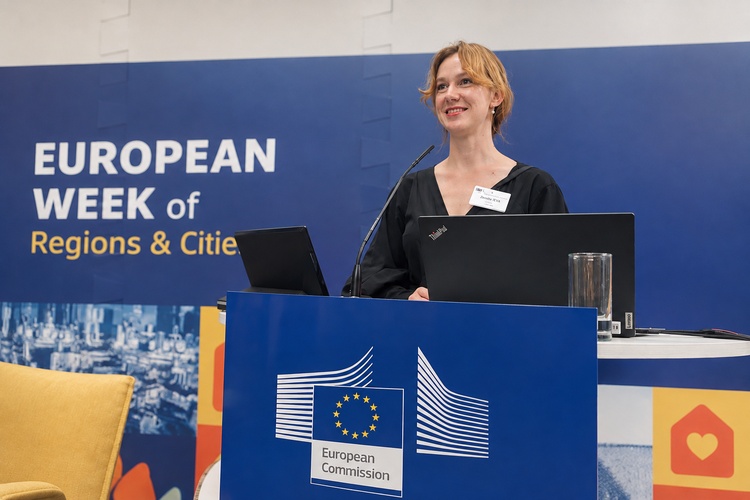
LAC Researcher Ieva Zemīte Highlights Women's Opportunities and Regional Development Potential at European Commission Policy Discussion
On 13 October, Ieva Zemīte, Associate Professor and Leading Researcher at the Latvian Academy of Culture (LAC), participated in the international policy discussion “Women Driving Regions Forward: Achievement, Innovation and Social Progress”, organised by the European Commission's Joint Research Centre (JRC) in Brussels. During the discussion, she shared insights from the gender equality and social well-being analysis conducted within the ACE²-EU European University Alliance and highlighted the potential of cultural and creative industries to contribute to regional development, drawing on research carried out at LAC.
The discussion took place as part of the European Week of Regions and Cities satellite event “Crossing Borders, Closing Gaps: New Evidence on Housing and Gender Equality across EU Regions”. The event aimed to demonstrate how JRC research and data can help identify disparities between European regions, uncover their untapped potential and develop place-based policy solutions tailored to local needs.
The event featured two expert panel discussions: one focused on women's contributions to regional economies, innovation and social progress, while the other addressed housing markets in the European Union's border regions.
JRC researchers Petra Krylova and Milene Tessarin presented the latest data on women's achievements and innovation across European regions, including the Female Achievement Index, which enables comparisons of women's achievements across different EU regions. The data reveal substantial disparities not only between Member States but also between regions within individual countries, while indicating a positive relationship between women's achievements and social progress.
One of the central issues discussed was the gap between women's high educational achievements and their opportunities to translate these achievements into professional careers, entrepreneurship and innovation. Although women are well represented in higher education, their share gradually decreases at the highest levels of academic and research careers.
Ieva Zemīte contributed to this discussion by sharing findings from the gender equality and social well-being analysis conducted across the nine ACE²-EU partner universities. The analysis, carried out within the Alliance's Social Impactors approach, highlights the need to examine not only formally equal opportunities but also the institutional and social conditions that influence professional development. Even seemingly neutral career evaluation criteria can produce unequal outcomes if differences in starting conditions, caring responsibilities and non-linear career paths are not taken into account. Gender equality is therefore closely linked to social well-being, a sense of belonging, safety and access to institutional support.
Another important focus of the discussion was women's entrepreneurship outside major economic centres and the potential of cultural and creative industries to contribute to regional development. The JRC presentation emphasised women's significant role in regional labour markets while highlighting development opportunities that remain underutilised.
These issues closely relate to research conducted at LAC on the role of cultural and creative industries in regional development, particularly the international research project Place-based Innovation of Cultural and Creative Industries in Non-Urban Areas (IN SITU). This research has placed particular emphasis on how local ecosystems, collaborative networks and support mechanisms influence creative entrepreneurs' opportunities to develop their activities and ensure that the value they create becomes visible, recognised and more widely utilised.
The panel discussion featured Panagiotis Ravanos, Quantitative Policy Analyst at the JRC; Oriane Gilloz, Gender Equality Policy Expert at the European Commission's Directorate-General for Research and Innovation; and Michael Green, CEO of the Social Progress Imperative. The discussion was moderated by JRC Quantitative Policy Analysts Petra Krylova and Milene Tessarin.
Bringing LAC's research findings into a European Commission policy discussion strengthens the participation of Latvian researchers in international knowledge and experience exchange, particularly on issues related to inclusive regional development, gender equality and the social and economic impact of cultural and creative industries. The discussion also highlighted the need for regional development policies to consider not only economic indicators but also social progress, equal access to resources and the importance of institutional support.
Prepared by Ieva Zemīte