

International Lab on Art, Technology and Urban Public Space Kicks Off in Riga
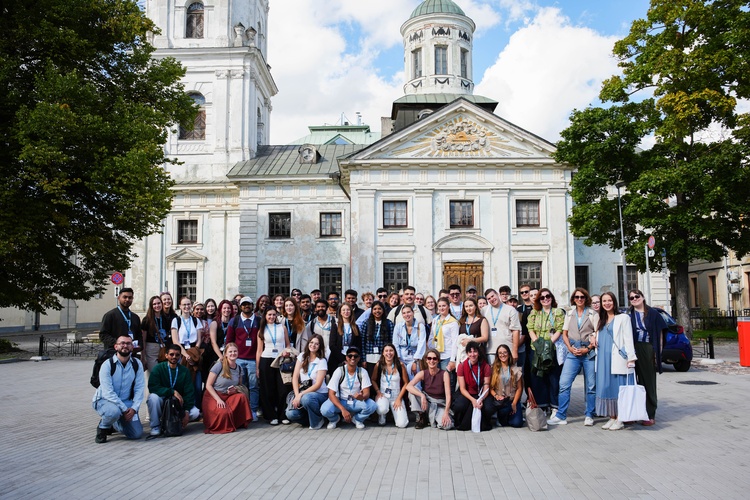
On 31 August, the Latvian Academy of Culture (LAC) launched the ACE²-EU European University Alliance microlearning programme “Urban Future Public Space LAB: Art, Design and Technology for People”. Running until 4 September, the programme brings participants together in an interdisciplinary creative lab to explore the urban environment and develop ideas for light-based artworks in public space. The programme is organised in cooperation with the “Staro Rīga” festival – Riga’s popular annual light festival, during which buildings, squares, parks and other urban spaces are transformed through light art installations. Over five days, students from nine partner universities, guided by international mentors, will combine perspectives from art, design and technology, working in teams from urban exploration and initial concepts through to prototypes and concrete implementation plans. The programme brings together 47 students from all nine ACE²-EU partner universities.
On the first day of the programme, participants formed interdisciplinary teams and set out to explore Riga’s urban environment, using sensory mapping methods, documenting their observations through photographs and sketches, and engaging in conversations with local residents. Over the following days, participants will gradually develop their ideas for specific locations in Riga.
On 1 September, the programme will feature the lecture and discussion “Light, Space and Public Art” with renowned Spanish visual and installation artist Javier Riera, followed by concept framing and development workshops. Teams will define the central theme of their projects, their target audiences and the type of light-based artwork they intend to create, while also developing the project narrative and exploring the role of light and performative aspects of their concepts.
On 2 September, the programme will focus on the technical implementation of light-based artworks. In the lecture “Technical Production for Light Interventions”, Hungarian artist and guest lecturer László Zsolt Bordos will address interactivity and performativity. During the practical sessions, participants will revisit and analyse their selected sites, take the necessary measurements, observe human behaviour in the urban environment and assess the technical feasibility of their ideas.
On 3 September, María Gutiérrez Pérez, lecturer at ACE²-EU partner institution Universidad Francisco de Vitoria in Madrid, will lead a session on prototyping approaches and strategies. Teams will develop project prototypes and scale models, carry out small-scale performative tests, and address practical aspects related to light sources, power supply, control systems, materials and construction.
The programme will conclude on 4 September with presentations of the projects developed during the lab. By then, the teams will have prepared not only their concepts and visual solutions, but also technical specifications, performative scripts and project implementation plans. During the final presentations, participants will explain their choice of location and project concept, present their design and technical solutions, and outline how their projects could be implemented.
Funded by the European Union. Views and opinions expressed are, however, those of the author(s) only and do not necessarily reflect those of the European Union or the European Education and Culture Executive Agency (EACEA). Neither the European Union nor the granting authority can be held responsible for them. Project No. 101177596. The project is co-funded by the Ministry of Culture of the Republic of Latvia.
Information prepared by Aija Lūse
_gCXXkmV.png)