

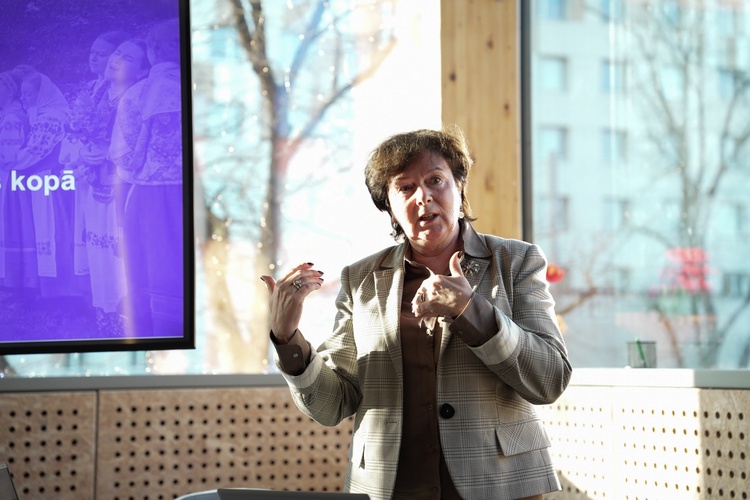
Do and how do we affirm ourselves as a “singing nation”? LAC seminar explores everyday practices of collective singing
On 9 March at 16:00, a seminar titled “Collective Singing Practices: Similarities and Differences in Latvia, Lithuania, Estonia and Denmark” took place at the Latvian Academy of Culture (LAC) Gara māja as part of the seminar series “Learn What You Don’t Know!”. The seminar focused on the social significance of singing together and its role in different historical and contemporary societal contexts. The event was organised within the framework of the research project “CRIES: Collective Singing in Times of Social Crises: Exploring Its Potential in the Nordic and Baltic Regions”, implemented by LAC within the EU research programme CHANSE (Collaboration of Humanities and Social Sciences in Europe).
The project is carried out by a consortium including Aarhus University, the Latvian Academy of Culture, the Institute of Lithuanian Literature and Folklore, and the University of Tartu.
The seminar continued the discussion on the social power of singing together and the identity of the so-called “singing nation”, addressing the question of why and in which situations societies choose to sing together and what role this practice plays during times of crisis and social change.
Project leader Prof. PhD Rūta Muktupāvela introduced the aims and tasks of the project, the work completed so far and the expected results. Within the project, collective singing is analysed from both historical and contemporary perspectives across the Baltic and Nordic regions, highlighting its significance in shaping national identity, strengthening social cohesion and fostering community resilience. As the researcher noted, collective singing from the second half of the nineteenth century to the present day has served as an important instrument for social solidarity, emotional mobilisation and the reinforcement of cultural identity, particularly in times of social crisis. The seminar emphasised that songs can both strengthen communities and delineate social boundaries, thus becoming important indicators of cultural and societal processes.
Project lead researcher Prof. Dr. sc. soc. Anda Laķe, drawing on a population survey conducted in Latvia, Lithuania, Estonia and Denmark, addressed the question of when, why and what people sing together today, analysing manifestations of collective singing in the everyday lives of residents of the four countries. A. Laķe emphasised that in Latvia collective singing is closely linked to the representation of national identity and society’s self-understanding – from folklore and the tradition of the Song and Dance Celebration to various contemporary informal forms of singing together. At the same time, the researcher encouraged a critical reflection on the notion of Latvia as a “singing nation”, raising the question of how those who do not identify with collective singing practices fit into this identity narrative.
The historical perspective was presented by project visiting researcher Prof. Dr. art. Valdis Muktupāvels, who focused on the repertoire of collective singing in Latvia and its social significance across different historical periods. Analysing song repertoires from the nineteenth century to the present, V. Muktupāvels demonstrated how collectively sung songs reflect societal values and political processes.
The seminar was complemented by creative activities that allowed collective singing practices themselves to become part of the science communication experience, encouraging participants to reflect on the emotional and social impact of singing together.
The seminar was organised within the framework of the CRIES project funded through the CHANSE (Collaboration of Humanities and Social Sciences in Europe) and HERA (Humanities in the European Research Area) programmes with support from the Latvian Council of Science (project No. ES RTD/2024/38). More about the project: https://www.lka.edu.lv/en/research/research-projects/international-research-projects/c-r-i-e-s/
Additional information
Aija Lūse
Science Communication Specialist Institute of Culture and Arts,
Latvian Academy of Culture
aija.luse@lka.edu.lv, +371 29107218